

Sicilian wines are now coming to the forefront of many consumers minds when they are looking for something new and generally slightly less expensive. Sicily can be divided roughly into three different macro-areas in terms of wine making. Western Sicily, near Trapani and Marsala, the North-Eastern region of the island known for the wines of Etna, near Catania and Taormina, and the Southern region of the island centered around the city of Ragusa. Cerasuolo di Vittoria, was named the first Sicilian DOCG wine a few years ago.

Sicily, together with the Veneto, Emilia-Romagna and Apulia produces the largest quantity of wine of any Italian wine region. Formerly the wines were mostly table wines and/or wines used to strengthen other wines. Vini da taglio in Italian means wines which cut or wines that are added to give more alcoholic vigor to weaker wines. Sicily has been long known for its indigenous white wine grapes such as Cataratto Bianco, Grillo and Grecanico. The newcomer which has made a big splash on the international scene is the indigenous grape Nero d’Avola, the King of Sicilian red wine grapes. It is also known as Calabrese. I often see other red Italian varietals such as Frappato on menus but not as much as I would like.

This is the flag of Sicily called the Trinacria. It was first created in 1282. The winged head represents Medusa and three wheat ears, according to an entry in Wikipedia. The bent legs instead are for good luck and prosperity. Trinacria was also the ancient name for Sicily.
Donnafugata, a winery near Marsala, is extremely well known on the international market and their stand at Vinitaly is unapproachable. Usually, I try to shy away from these types of wineries and prefer to try something from a smaller producer however I am an unbashed fan of most of Donnafugata’s wines. Whether it is their Tancredi made from Nero d’Avola and Cabernet Sauvignon or Angheli made from a blend of Merlot and Nero d’Avola or the two wines made from 100% Nero d’Avola Sedara, and Mille e Una Notte, I am always transported back to trips I have taken to Sicily and memorable experiences related to that region. These are heady wines and while it sounds extremely trite, they evoke that passion that one associates with Sicilians. Donnafugata also makes delicious white wines such as Lighea from Zibibbo and Catarratto, Anthilia from Ansonica and Catarratto and Vigna di Gabri from Ansonica. My favorite wine from Donnafugata, however, is the exquisite Passito di Pantelleria Ben Rye’ .

This naturally sweet wine is made from the Zibibbo grape which is actually Moscato d’Alessandria. Zibibbo is grown on the island of Pantelleria. The vines are trained in the low bush style and are grown in volcanic soil. Pantelleria is one of the few Italian islands I have not yet had the good fortune to visit. The wine is made from grapes from a host of different sites on the island picked at various intervals. Some grapes are left to raisin on the vine while others are picked immediately and then put under cooling temperatures to preserve their aroma and flavor profile. The dried grapes are eventually added to the must. The wine is aged in stainless steel for four months and in the bottle for a further six months.

I confess I have always wanted to sail around Pantelleria not just enjoy this delicious Passito but I surmise that one can do both. In some ways I am excited to have this journey ahead of me at a future date. I often feel envious of people who can experience say Florence for the first time. It’s like falling in love the first time, so grand, so special and so new. I digress…
I first tried Donnafugata wines some years back thanks to an Italian Sommelier friend at MIWINE , a trade show in Milan where I worked as a Sommelier and I have been hooked ever since.

Avant-garde in terms of its wine making techniques and management style, Donnafugata is headed by José Rallo. The winery was started in 1983 by Giacomo Rallo and his wife Gabriella. Josè is the next generation and leads this innovative winery. The historic winery lands are located near the towns of Marsala and Contessa Entellina on the western coast of Sicily. Marsala is best known for the dessert wines of the same name. The Rallo family restructured and expanded its wine cellars and then further developed a project on the small island of Pantelleria, making dessert wines from the indigenous grape Zibibbo.

The name Donnafugata comes from the legendary novel, “Il Gattopardo” or “The Leopard” by Giuseppe Tomasi di Lampedusa. It was published by Feltrinelli after his death after having been passed over by the publisher Einaudi, a tremendous mistake. That novel is extraordinary in its depiction of Sicilian life and a must read for anyone hoping to understand Sicily. Often, it seems to still be an appropriate description of the immutable nature of Italy. It describes a world where no matter what happens, nothing really ever changes. One of the most famous quotes from the novel is “Se tutto deve rimanere com’è, è necessario che tutto cambi.” If everything is to remain as it is, then it is necessary that everything changes. That is a quality that I find true today in Italian life but not one that always displeases me. In some ways, it is very frustrating while it can also be strangely reassuring. I worked for three years with a group of Sicilians. It was very enlightening and a totally different experience. In the novel, the name Donnafugata is associated with country properties which the novel’s protagonist, the Prince of Salina, owns. The Rallo family’s Santa Magherita palace where Lampedusa spent his summers was the backdrop for many of the most important scenes in the novel.
INTERVIEW
I sought out José Rallo for a chat some time ago. She was lovely, very welcoming and excited to talk about her winery.
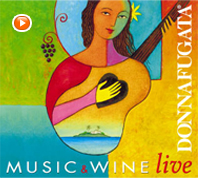
Like many of her Northern counterparts, she sees wine production in a larger context. “Wineries must be attentive to consumer needs. Consumers are more informed and companies need to be aware that consumers choose their products not only for the product itself but because they agree with the company’s values and mission,” Rallo notes. At Donnafugata, the values that they are exposing include using clean energy in the wine cellars, promoting local grape varieties to underline their Sicilian identity and wine consumption as part of a 360 sensory experience. To underscore this point, Rallo, who is also a singer, has created a band, which goes on tour throughout Italy and abroad. The band has already come out with two CDs.

“The idea is to create an environment in which we match various instruments, such as a harmonica with a specific wine, such as our wine Tancredi, which provides a deep, elegant experience,” Rallo states. Donnafugata is very attentive to the marketing of its products. “In Australia, the average winery spends 15% of their revenues on marketing. In Italia, we spend 3% and we have to compete with the higher costs of our wines as well. No wonder many new consumers are moving towards new world wines,” Rallo laments. Donnafugata spends some 10%-11% of its revenues on marketing. Undertaking these risks has been paying off. Donnafugata currently distributes its wines in most of the world’s markets including China. “We need to diversify our risk by constantly looking at new markets. We can’t hide from the competition and complain about others’ initiatives. We must put ourselves out there and make our products known. Donnafugata is proud of its Sicilian heritage and we want to be the expression of ‘Made in Sicily,’ Rallo states.

Another aspect of Donnafugata that sets it apart from many Italian wineries in general and in Sicily particularly is the attention that it puts on promoting women in wineries. Women bring a certainty sensitivity to the world of wine that adds a new dimension to the concept of a winery. “The fact that women are mothers and are responsible for creating the home environment is often translated into actions taken in the winery,” Rallo noted. “Women are very concrete and look at the context of the environment where they work. At Donnafugata we have taken an interested in the local schools, hospitals and digs in the surrounding area,” Rallo continues. Donnafugata teams with the Giuseppe Tomasi di Lampedusa Institute which sponsors a prestigious literary award.

José Rallo is not the only musician in the family. Her husband, Vincenzo Favara plays percussion in their band. The repertory ranges from jazz to Brazilian music. The have played at the Blue Note in New York, in Moscow and a variety of other locations. Quite a pair. The wines are imported into the United States by Folio Fine Wine Partners.
 avvinare.com
i have a bottle ben rye’ in my fridge…so good! moscato non si smentisce mai. and i love the anthilia…have you ever had the dry zibibbo “yrnm” by miceli? another good one.
Tracie b.,
I most certainly have. My friend, Barbara Tamburini, is the winemaker for that wine and I had some with her this summer. I love Micheli’s passito as well. Grazie per la visita stellina nella cucina.
s.