


I love sweet wines and today I had the chance to taste three different vin santo wines made from various grapes. Each wine was an exciting project for their wineries and ones that required a lot of care and hand holding. Tonight at a dinner for Capezzana, we were told that their winemaker, Benedetta Contini Bonacaossi checks on the grapes three times a day , 7 days a week when they are drying in the Vinsantaia. Their particular Vin Santo is made from a. blend of Trebbiano Toscano and San Colombano, a less well known indigenous grape. The wine has been produced since 1925, the year they made their first harvest.
Capezzana’s vineyards are at 100-150 meters above sea level and face East. The soils here are Schist and Clay.
A careful selection of grapes are picked in the middle of September and then dried for five months on cane mats until January of the following year. The wine is vinified in barrels known as Caratelli and there it remains for 7 years. The caratelli tend to be made of Chestnut, Cherry, Oak. The wine is usually bottled for three months and when it is released it has 14% alcohol and 280g/l of residual sugar. We tried the wine paired with some cheeses although it would also be great with traditional cookies or dry desserts. It really is such a treat on its own.
It was a beautiful amber color with intense aromas of candied and dried fruits, apricot, and fig notes came through on the nose and palate. The wine was had lovely acidity and freshness and was very persistent on the palate with a long elegant finish to an important tasting and meal.
The Capezzana wine was a Vin Santo Carmignano Riserva DOC

Earlier in the day, I tried a Vin Santo del Chianti DOC 2016 from Tenuta San Vito called Malmantico. I have known the owner, Neri Gazulli, of this winery for many years and have tried this wine but not the current vintage before. Made from 100% Malvasia Toscana. It has about 45g/l of residual sugar with 15% alcohol. The winery has been organic since 1985.
The grapes dry on mat until December after the October harvest and are then pressed. The wine ages in Caratelli for at least three years before it is bottled. the 2016 is their current vintage after 7 years of aging. This particular version of Vin Santo is very dark amber in color, tending towards a browner hue. Lovely dried fig and salted caramel come through here with honey. Here again the acidity and the sweetness have a fine balance. I tasted it during the walk-around portion of the Chianti DOCG/Morellino di Scansano event.
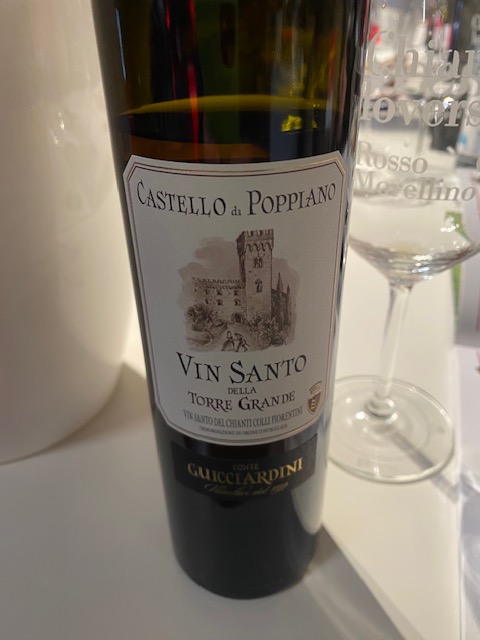
The third Vin Santo I tried was from Castello di Poppiano. Again, I have known the owner, Conte Ferdinando Guicciardini for some time and have tried their Vin Santo in the past. I did not remember that Vino Santo della Torre Grande Colli Fiorentini as it is called is a drier version of this luscious sweet wine. I have visited their Vin Santaia where the dried Malvasia Toscana grapes are laid out for 4 months before being pressed. They too use Caratelli di either Chestnut or Oak wood. The resulting wine which is released after at least 3-4 years has 17% alcohol after the almost complete fermentation of the sugar. The wine has lovely dried fruit notes and beautiful acidity. Made from Malvasia, this traditional product was a perfect end to the tasting portion of the day’s event.
 avvinare.com