

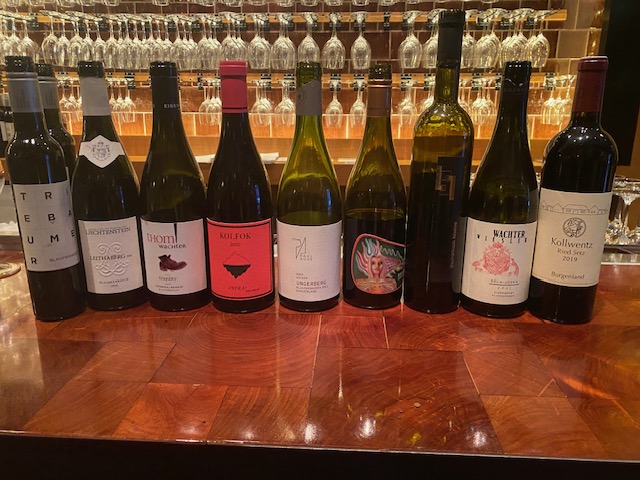
Another highlight from this past year in wine was a Masterclass on Blaufränkisch held by Wein Burgenland‘s very own Christian Zechmeister, their Managing Director at Corkbuzz in October. Thanks to Constance from Wine and Co, I received the invitation and I was super excited because I have always enjoyed Blaufränkisch but didn’t know a lot about the grape. Grown largely in Austria, this red grape variety accounts for a small percentage of the overall production. Austria is really thought of more as a white wine country while in terms of red varieties, more Zweigelt is grown than Blaufränkisch. Apparently red wine making really only began in earnest in the 1990s.. For a time, the wines were overoaked but the style has changed and now many are experimenting with different winemaking regimes.
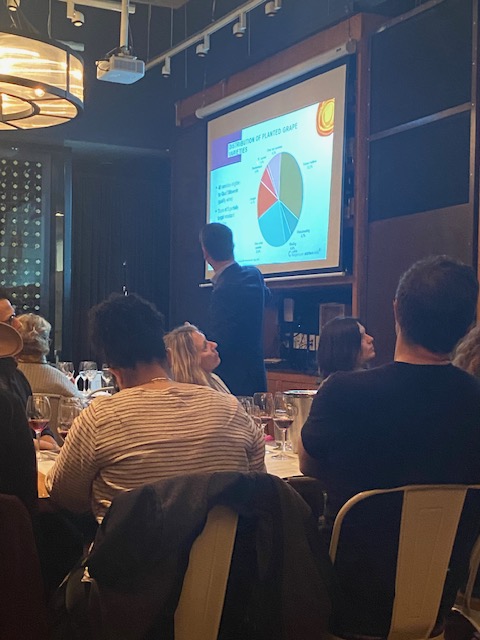
Blaufränkisch is a cross between two grapes Gouais blanc and Blaue Zimmettraube. A late ripening grape, it is also a parent of both Gamay and Zweigelt. Deep purple in color, the wine flavors include black cherry, dark chocolate, pepper, and forest floor. The grape can also be called Lemberger and grows in Hungary and Croatia as well. I once had a Blaufränkisch from Channing Daughters on Long Island which I loved but mostly this is an Eastern/Central European grape variety. Much of it grows in Burgenland in four separate area: Neusiedlersee, Mittelburgenland, Leithaberg, and Eisenberg. The grape tends to like sandy soils.
We tried a number of wines in different flights. In the first flight I enjoyed the wine from Triebaumer which was a 2021. Deep ruby red it has a muted candied nose with fresh red fruit, jam, and spice on the palate. A long finish with medium alcohol and fine tannins. The soils here were leaner cool soils and the wine was quite straight-forward. I also really liked the wine from Eisenberg that we tasted that came from Thom Wachter called Reserve Ried Szapary 2019. Apparently all vintages that end in 9 in this area are really exceptional. I loved the texture on that wine with it’s notable acidity and blueberry notes.
In the second flight, again a wine from Eisenberg really stood out this time from Wachler Wiesler called Bela Joska 2021. Really deep in color almost purple/black and opaque, it had lots of bacon, pepper, spice and. oak with a long finish and finely integrated tannins and acidity.
Flight number three was focused on single sites rather than styles or origin like the first two flights. Here my preference was for the Ried Szapary 2019 from Jalits winery in Badersdorf. It came from old vines, 40-70 years old, and had blue/black fruit on the nose and palate, it was very complex with layers of flavor, mineral notes, and spice and a long finish, again a 2019.
The final fight was a group of wines that were 10 years old. They were all a treat and showed just what a noble variety this one can be and how it can develop with age. Here a wine called Ried Marienthal 2013 from Prieler winery was captivating with blue and red fruit on the nose and palate, some serious leather, animal notes, lots of good racy acidity, and a good structure and long finish. This was a really fun wine as was the one from Moric winery called Alte Reben 2013. This one had more minerality and spice than the previous one but also more cedar and oak flavors. It had a very long length and was quite persistent. The tasting was one of the highlights of the year. I learned so much about the grape variety, what it can produce now and how the wines can develop with time. I also learned about the terroir in these four areas of Burgenland, all of this was new to me. It was fun to taste Austrian wine which is not my go to area but I look forward to learning and tasting more of these wines in 2024.
 avvinare.com